Get a Free Quote in Under 24 Hours


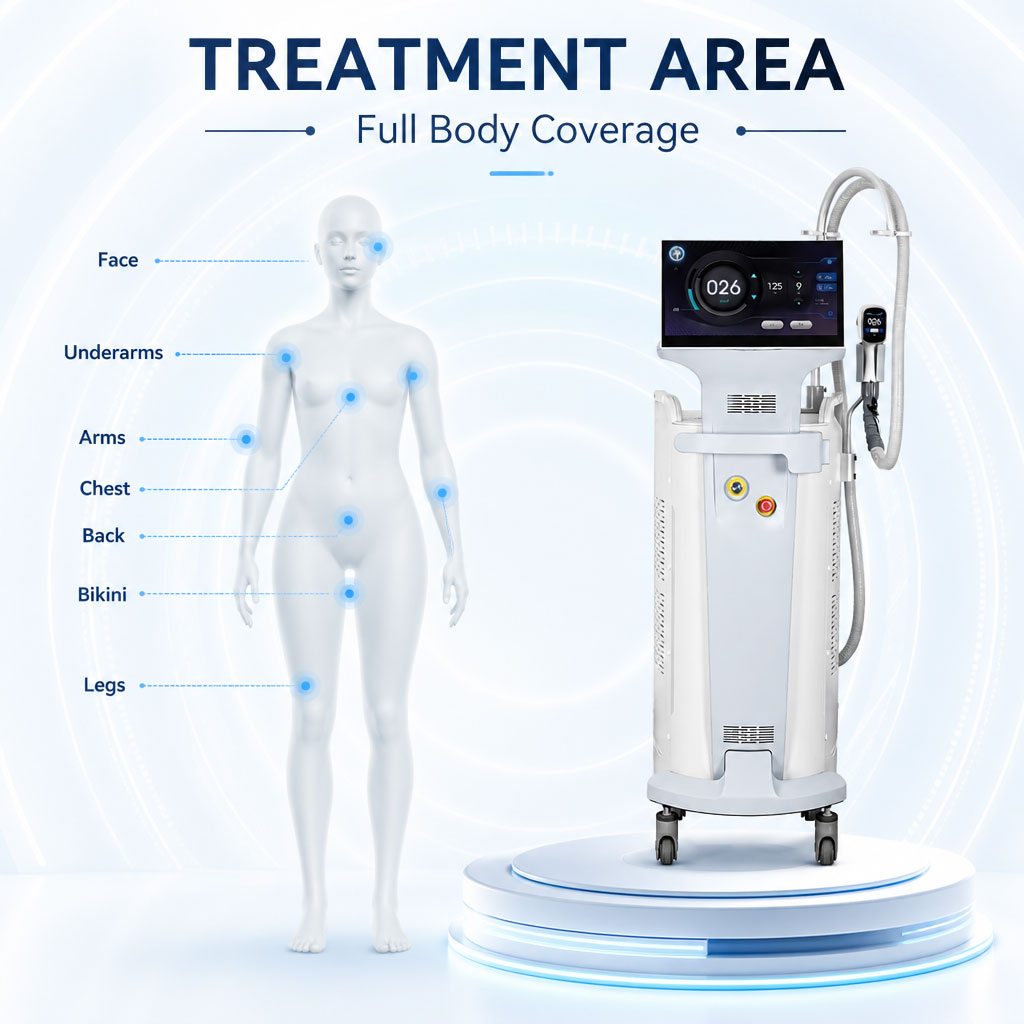
A diode laser hair removal machine treats hair by selective photothermolysis. Light is absorbed by melanin in the hair shaft, follicle and bulge, converted to heat, and held there long enough to damage the structures that regrow hair. The target is follicular melanin. The obstacle is epidermal melanin, which lies in the same optical path and absorbs the same photons.
Everything below follows from that conflict. On light skin the two targets are well separated, so high fluence can be delivered safely. On dark skin the epidermis absorbs a meaningful share, so a fluence routine on Fitzpatrick II becomes a burn risk on Fitzpatrick V. “All skin types” is therefore not a property a manufacturer switches on in hardware. It comes from pairing a wide enough wavelength range with a protocol that changes everything else: which wavelength leads, pulse duration, cooling intensity, spot size, and whether a test spot was performed. The 755, 808, 940 and 1064 nm outputs sit at different points on the melanin absorption curve, so the operator can shift the treatment window instead of forcing one wavelength onto every patient.
Brochures present multi-wavelength platforms as a menu: pick the wavelength that suits the patient. In practice the wavelengths are used in sequence within one session, and the sequence matters as much as the selection.
| Wavelength | Melanin absorption | Depth behaviour | Role in a protocol | Main limitation |
|---|---|---|---|---|
| 755 nm | Highest of the four | Shallowest useful depth | Fine and medium hair on lighter skin; facial work | Narrow margin on tanned or Fitzpatrick IV+ skin |
| 808 nm | Balanced | Medium depth | Default for types II-IV, medium-to-coarse hair, large areas | Still competes with epidermal melanin at type V |
| 940 nm | Lower | Deeper than 808 nm | Coarse hair where epidermal pigment competes | Lower absorption, so more fluence is needed |
| 1064 nm | Lowest of the four | Deepest | Types V-VI, coarse deep-rooted hair, darker areas | Weak on fine, light hair; needs longer pulses |
Two consequences follow. A clinic treating mostly light-skinned patients with medium hair gains little from 940 nm and 1064 nm and should not pay for capability it will not use. And a mixed-population clinic cannot substitute a single wavelength by raising energy on the shorter one: raising fluence on 755 nm to reach a deep follicle on type V skin heats the epidermis in the same proportion, which is the trade the longer wavelengths exist to avoid.
Safety is governed by the ratio of energy absorbed in the follicle to energy absorbed in the epidermis, not by a colour category. Two patients can both be Fitzpatrick IV and behave very differently: one has uniform baseline pigment, the other has just returned from a holiday with a tan on the treatment area. The second has temporarily become a higher type in optical terms. A test spot is the only direct measurement a clinic has of how one patient’s skin responds to one wavelength at one fluence, which is why it is not a formality.
Wavelength decides where the light goes; pulse duration decides where the heat stays. The epidermis is thin and cools quickly, the follicle is larger and retains heat longer. A pulse long enough lets heat diffuse out of the epidermis while the follicle is still accumulating damage. That is why dark-skin protocols rely on longer pulses at lower fluence, and why a machine whose pulse range stops at a short value cannot be made safe on high-melanin skin by turning power down alone.
Contact cooling protects the epidermis during the pulse and reduces the discomfort that makes operators rush. Semiconductor, or TEC, stack cooling and sapphire contact cooling solve different halves of the problem: the stack and the skin. A platform that lists cooling as a single word in a brochure should demonstrate it under continuous load, because performance adequate for a short facial is not enough for a full-leg session.
The useful question is not which wavelength belongs to which skin type, but what the operator changes when the type changes. The table is a planning framework, not a prescription.
| Type | Wavelength emphasis | What changes in the protocol | What to watch |
|---|---|---|---|
| I-II | 755 nm and 808 nm | Higher fluence tolerated; shorter pulses viable; large spots speed body work | Seasonal tanning; underestimated sun exposure |
| III-IV | 808 nm primary, 940 nm support | Moderate fluence, longer pulse, routine test spot, overlap discipline | Recent sun, melasma history, hormonal hair patterns |
| V | 808 nm and 1064 nm, 940 nm where useful | Lower fluence, long pulse, aggressive cooling, test spot mandatory | Epidermal heating; post-inflammatory hyperpigmentation risk |
| VI | 1064 nm primary | Conservative fluence, longest pulses, cooling confirmed every session | Highest pigment risk; 755 nm normally excluded |
Three patient factors cut across the table. Tanned skin should be treated as a temporarily higher type and the session deferred. Grey and white hair contains little or no melanin, so none of these wavelengths absorb well in it; the honest answer is that treatment is unlikely to work. Fine, light hair on dark skin is the hardest combination in the category, and where expectations are most often set unrealistically.
Most buying decisions are not between two diode lasers but between a diode laser and a different technology. The comparison is blunt about limitations, because a clinic that knows what a platform cannot do will price and position it correctly.
| Platform | How it works | Strength | Limitation | Best fit |
|---|---|---|---|---|
| Four-wavelength diode | Multiple diode wavelengths, selectable | One platform across the Fitzpatrick range; steady body-area throughput | Higher price; more parameters to learn | Mixed-population clinics and multi-market distributors |
| IPL | Broad-spectrum filtered flashlamp | Low cost, large spot, fast coverage | No wavelength selectivity; weaker on coarse hair | High-volume, light-skin markets |
| Alexandrite only (755 nm) | Single short wavelength | Strong absorption; fast on light skin | Poor margin on darker or tanned skin | Clinics treating almost only types I-III |
| Long-pulsed Nd:YAG (1064 nm) | Single deep wavelength | Most forgiving on high-melanin skin | Weak on fine light hair; slower on large areas | Markets dominated by types V-VI |
| Feature | Advantage | Benefit to the patient | Benefit to the clinic |
|---|---|---|---|
| Four selectable wavelengths (755/808/940/1064 nm) | Treatment window shifts to match skin and hair type | One provider can treat the whole family | Wider caseload without a second platform |
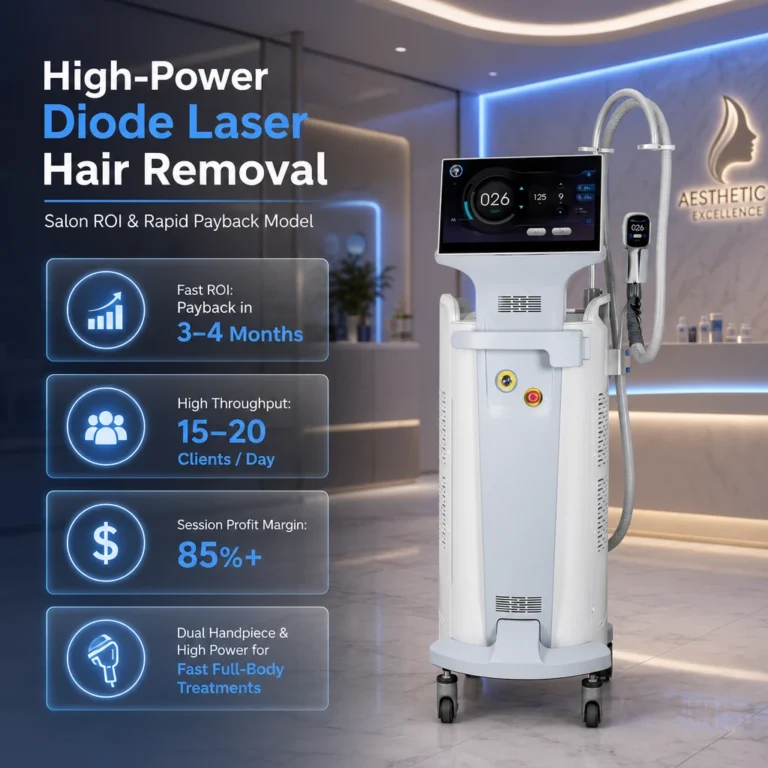
| 1200 W and 1800 W configurations | Power headroom for large spots and sustained throughput | Shorter sessions on legs, back and chest | More appointments per day at the same room cost |
| Semiconductor (TEC) stack cooling plus contact cooling | Stable output during long sessions, controlled epidermal temperature | More comfortable treatment, lower injury risk | Fewer complaints, longer handpiece life |
| Interchangeable spot sizes | Small spots for facial precision, large spots for body coverage | Better fit to the treatment area | One handpiece covers more indications |
| Calibrated output and documented bar specification | Delivered energy verified rather than assumed | Consistent results between sessions | Parameters auditable, staff trainable against measured values |
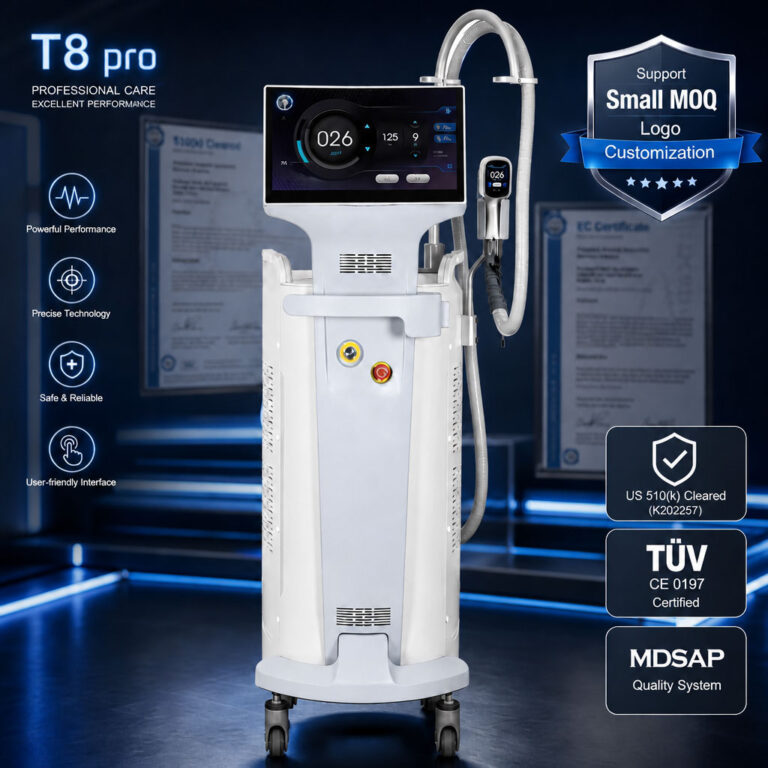
| Documented quality system (ISO 13485, MDSAP) | Manufacturing and traceability records exist for the unit | Device history is traceable | Simplifies import registration and distributor due diligence |
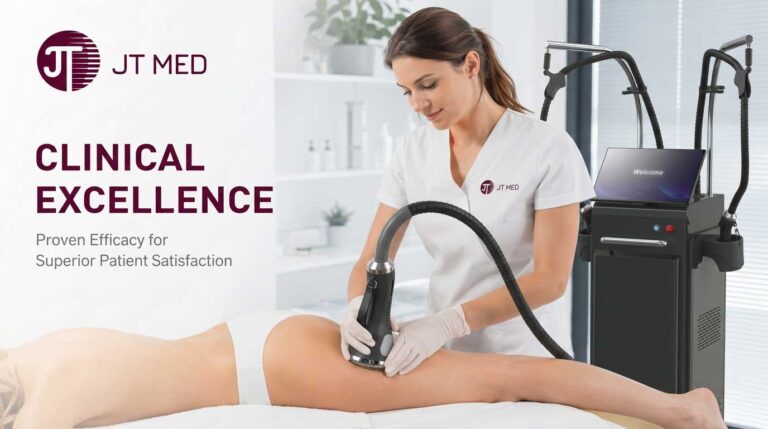
The diode laser range is manufactured by Beijing JONTELASER Technology Co., Ltd., trading under the JT MED brand for premium medical aesthetic channels. The company was founded in 2004 and exports to more than 50 countries. Production runs under an ISO 13485 quality management system with MDSAP audit coverage, and technical documentation is prepared to align with CE, FDA and TGA requirements for the markets served.
Two qualifications matter. Regulatory status is model- and market-specific: a certificate held for one configuration does not automatically cover a different power class, wavelength set or handpiece, so buyers should request the document for the exact unit. And quality-system certification confirms a controlled process; it does not by itself describe clinical performance.
Ask for the registration or clearance document naming the model, power class and wavelength set you are ordering. Multi-configuration platforms are often certified in one configuration and sold in another.
Request a measured energy reading at the handpiece for each wavelength and spot size. Display values describe the setting; delivered values describe the treatment. A unit that loses output through the optical path will silently under-treat.
Bars are the consumable heart of a diode platform and the main driver of lifetime cost. Ask which bars are used, how degradation is monitored, and what a replacement costs and takes to fit.
Run the handpiece for the length of your longest real appointment, not two minutes. Confirm that contact and stack temperatures stay stable and that output does not derate without warning.
A four-wavelength platform is only as capable as the person choosing the wavelength. Training should cover Fitzpatrick assessment, test-spot technique, pulse selection, overlap discipline and the decision to defer a tanned patient.
It can, with 1064 nm leading, conservative fluence, the longest available pulse, strong contact cooling and a mandatory test spot. It should not be presented as equally easy to deliver as a type II treatment. The higher the epidermal melanin, the narrower the window between effective and injurious.
Start with 808 nm for the bulk of the area, because it balances absorption and depth for types III-IV. Add 940 nm where hair is deep and coarse or the epidermis absorbs more than expected. Reserve 1064 nm for cases where 808 nm cannot be pushed safely.
Switching between passes is common and useful, provided total energy delivered to the area is tracked. Two passes at moderate fluence with different wavelengths can deposit more epidermal heat than one pass at higher fluence, because the interval between passes is short.
Both, partly. It is safer on high-melanin skin because less energy is absorbed in the epidermis, and less efficient on fine, light hair because less is absorbed in the follicle as well. The property that protects the skin also weakens the target.
Defer. Treat the tanned area as a temporarily higher Fitzpatrick type, reschedule once the tan has faded, then re-assess instead of resuming the previous parameters. This is the most common preventable cause of superficial injury in diode laser practice.
Very little. These wavelengths depend on melanin absorption, and grey or white hair has lost most of it. State the limitation before taking payment and offer an alternative or partial plan.
Not by themselves. Session count is driven by growth cycles, hormonal factors, hair colour and area. Multiple wavelengths improve the ability to treat a patient safely and to address mixed hair types in one area; they do not change how many follicles present in the active phase each month.
The higher power class gives headroom to sustain high fluence at a large spot and keep repetition rates up during long sessions. It does not automatically produce better results on a small area, and costs more to buy and run. Choose by the largest area you treat regularly and patients per day.
At minimum the certificate for the specific model and configuration, the technical file summary, the quality-system certificate, the test and calibration report for the serial number, and labelling in the destination market’s language. Ask for the pack before paying the balance.
Confirm spot size physically, verify output at each wavelength against the acceptance report, inspect cooling surfaces and the optical path, and record handpiece and bar serial numbers against the invoice. Photograph the packing and nameplate before the unit enters service.
JT MED supplies the 755/808/940/1064 nm diode laser hair removal platform in 1200 W and 1800 W configurations, with interchangeable spot sizes, semiconductor stack cooling and contact cooling, and full documentation for clinic and distributor procurement. The export team can provide the configuration sheet, measured output report, certificate set for the target market, consumable pricing and a training outline by skin type.
Send your treatment mix, the Fitzpatrick range of your population, your target throughput and your destination market. The team will return a configuration recommendation and a quotation rather than a generic catalogue.