Get a Free Quote in Under 24 Hours



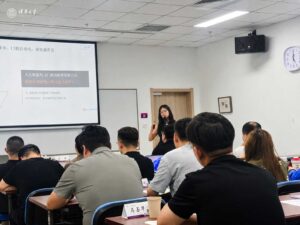
Beijing JONTELASER Technology Co., Ltd. General Manager Karen Liu recently delivered an in-person masterclass at Tsinghua University’s School of Continuing Education, teaching small and medium-sized export businesses how to run the entire cross-border trade chain with AI. This article reports what she taught — and then turns the camera around. For a clinic owner, distributor, or procurement manager buying medical aesthetic equipment from China, the interesting question is not whether a supplier uses AI. It is what an AI-operated export desk visibly changes in the quotation, the documentation, and the follow-up you actually receive.
Karen Liu is General Manager of Beijing JONTELASER Technology Co., Ltd., a manufacturer of medical aesthetic devices founded in 2004 that exports under the JONTELASER and JT MED brands to more than 50 countries. She was invited to the School of Continuing Education as a practising exporter who has already rebuilt a real B2B sales operation around AI — not as a vendor presenting a product, but as an operator describing a workflow.
The session ran as an in-person masterclass within an Alibaba International Station merchant growth course, for an audience of SME foreign trade owners and cross-border e-commerce programme participants. The framing was deliberately unglamorous: Liu opened on a slide titled “Watershed”, arguing that AI had moved from productivity experiment to competitive necessity for exporters trying to win inquiries and hold margin in a crowded B2B market.
| Speaker | Karen Liu, General Manager, Beijing JONTELASER Technology Co., Ltd. |
| Venue | School of Continuing Education, Tsinghua University, Beijing |
| Audience | SME foreign trade owners and cross-border e-commerce programme participants |
| Format | In-person masterclass, Alibaba International Station merchant growth course |
| Themes | AI across the full cross-border chain · AI for foreign trade sales · enterprise-wide adoption |
Liu organised the session around three layers, moving from tools to organisation.
The first layer treated AI as a connected sequence rather than a set of isolated tools — market research and product selection, content creation, listing optimisation, inquiry handling, customer follow-up, quotation drafting, and logistics coordination. Her argument was that the value appears at the joints between these steps. An exporter who automates quotations but still researches markets by hand has bought a faster engine and kept the same gearbox.

The second layer went past generic chatbot use into B2B selling: generating multilingual product content, building buyer profiles out of inquiry data, drafting quotations and negotiation scripts, running follow-up sequences, and personalising communication for distributors in different regions. The objective was to convert raw leads into qualified opportunities with less manual effort.
The third layer was the one Liu spent most time on. Her framework — “thinking, mindset, organisation” — was illustrated with a training-versus-coaching diagram. Tools can be taught in a training session, she argued; the companies that hold an advantage are the ones that invest in coaching, embedding AI into daily habits, management routines, and team structure. Technology, in her phrasing, is the easy part. The organisation is the real transformation.
The most quoted line of the session was a warning rather than a promise: once every competitor can run the cross-border chain with AI, the efficiency window may last only about half a year. Liu’s supporting claim was that AI-driven visitor leads convert at significantly higher rates than traditional sales inquiries — and her conclusion was that the dividend is real but will be quickly consumed by homogenisation.
Read carefully, that is an argument against treating AI as a differentiator and in favour of treating it as table stakes. A supplier that markets AI as a feature describes a temporary condition; one that has absorbed it into its routine describes something a buyer can test.
Here the lecture stops being a story about exporters and becomes useful to the people who buy from them. When an export desk is genuinely AI-augmented, four things become observable to a clinic or distributor.
None of this makes equipment safer or clinically better. It makes the commercial process around the equipment legible — and legibility is what allows a buyer in a distant market to judge a supplier on evidence rather than on the quality of its English.
To test whether a supplier’s process is real or rhetorical, ask questions whose answers require an actual system behind them.
| Ask | A credible answer looks like |
| Can you resend my last quotation with the same part numbers? | Identical line items returned quickly, not a re-typed estimate |
| Which document version am I reading? | A revision number and a date on the manual or spec sheet |
| Who handles my account after the deposit? | A named contact with a defined escalation path, not a shared inbox |
| What does training actually include? | A scheduled curriculum, not a promise of “free training” |
| Which standards apply to this model? | Specific standard references, with the certificate or declaration attached |
Liu’s own framing concedes the boundary. A language model can draft a quotation; it cannot calibrate a laser. It can translate a protocol; it cannot decide whether a device suits a given market’s regulatory pathway. Those remain engineering and compliance functions, which is why manufacturers here are judged on quality management rather than marketing velocity.
Beijing JONTELASER Technology Co., Ltd. has designed and manufactured professional medical aesthetic devices since 2004, operating under ISO 13485 quality management with compliance documentation aligned to CE and FDA clearance requirements. The JT MED portfolio spans body sculpting, laser, HIFU, RF microneedling, and skin care platforms, supported by training, marketing resources, and OEM/ODM services for partners in more than 50 countries.
A general manager teaching at Tsinghua is, on its own, institutional news. What makes it relevant to a clinic in another country is the operational claim underneath it: that the discipline being taught to SME exporters already runs inside one manufacturer’s own export desk. Buyers can verify that claim in a week — by sending one configuration question twice and comparing the answers.
Partners and distributors interested in the JT MED range, private labelling, or OEM projects can request the current specification set and compliance documentation directly from the JONTELASER team.