Get a Free Quote in Under 24 Hours


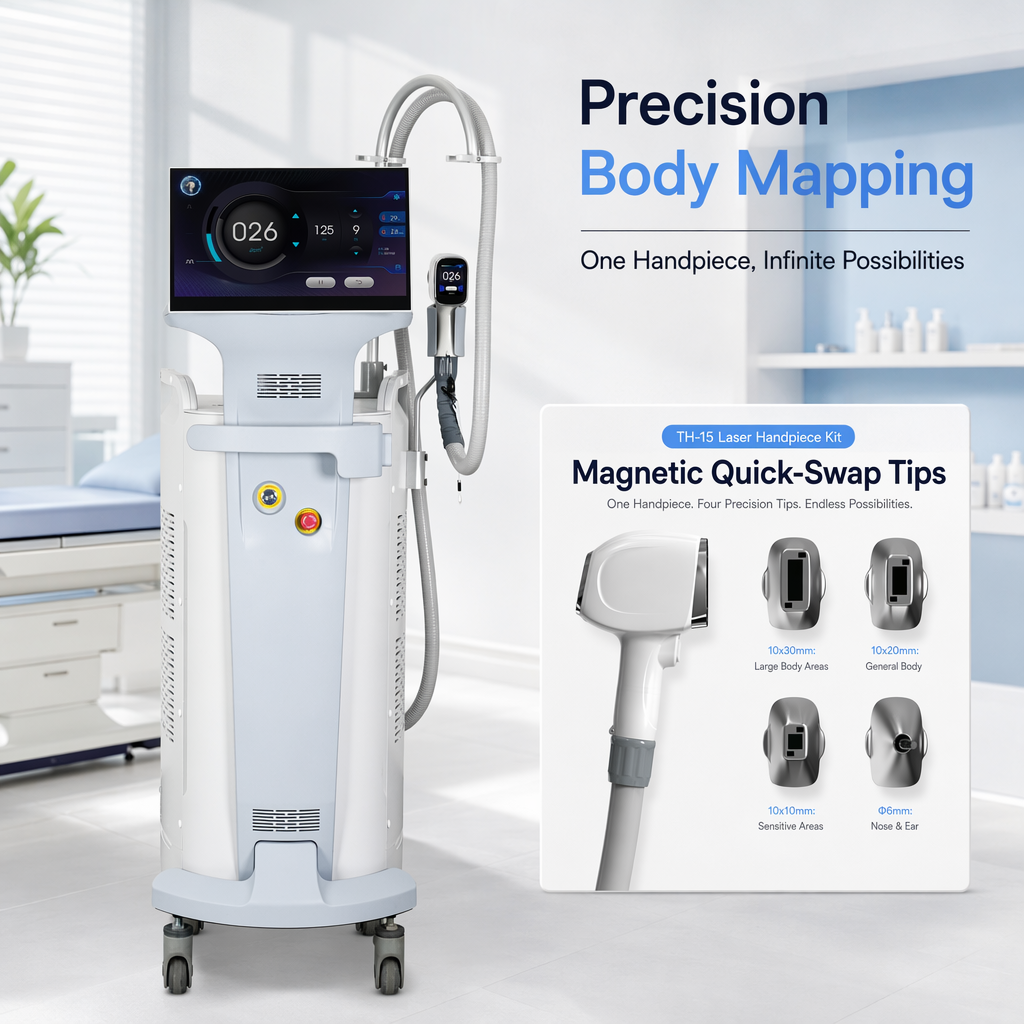
Most clinic owners evaluate diode laser hair removal equipment the way they evaluate an expensive consumable: price, then features. That framing tends to produce disappointing outcomes, because a diode platform is not a consumable. It is the production asset behind a service line, and its value depends on how much billable work it can reliably complete over its service life.
Hair removal has a structural advantage over many aesthetic procedures: it is a course-based treatment. A single patient typically requires multiple sessions spaced over months, which means the machine that wins the first session usually retains the patient across the entire course. The revenue from one satisfied patient is therefore not one session but an entire treatment plan, and the machine that delivers that plan comfortably becomes the reason the patient returns rather than shops elsewhere.
This is the distinction that separates a profitable diode investment from an expensive one. A unit that covers more skin and hair types keeps more first-time enquiries from being turned away. A unit that treats efficiently keeps appointment slots productive. A unit that patients tolerate well keeps course completion rates high, which is where the compounding value sits.
Diode laser hair removal uses an array of semiconductor emitters to deliver light at a wavelength that melanin in the hair follicle absorbs preferentially. Absorbed energy converts to heat in the follicle, and sustained heating across the growth cycle impairs the follicle’s ability to produce new hair. Because the target is the pigment in the follicle rather than the surrounding skin, the practical challenge is not the principle — it is delivering enough energy to the follicle while keeping the skin surface cool enough that the patient completes the course.
That challenge explains why cooling architecture is a commercial specification rather than a comfort detail. Semiconductor (TEC) cooling integrated with the handpiece allows higher fluence to be applied with less surface discomfort. If cooling is weak, the operator has two bad options: reduce energy and accept slower, less effective sessions, or push energy and accept higher discomfort and a greater risk that patients skip or abandon remaining sessions. Either way, the effect lands on the service line’s economics — either fewer patients per hour, or fewer sessions per patient.
Power tells the same story from the other direction. Diode platforms are commonly offered in 1200 W and 1800 W configurations. The higher configuration exists to support faster coverage of larger areas such as legs and backs, and to keep pulse delivery stable during long sessions. Whether the higher rating pays for itself depends entirely on your case mix: a clinic whose bookings are dominated by small-area treatments gains little from throughput it never uses, while a clinic running high-volume full-body work will feel the difference in the appointment book.
Hair removal performance depends on matching wavelength to the relationship between melanin in the hair and melanin in the surrounding skin. A 755 nm wavelength is strongly absorbed by melanin; 808 nm is the widely used middle ground for permanent hair reduction; 940 nm trades some melanin absorption for deeper penetration; 1064 nm is the least absorbed by superficial melanin and is generally the most forgiving option on darker skin tones. A platform that combines these wavelengths gives the operator room to select an appropriate setting rather than reject a patient outright.
Commercially, this is the single most important specification. Every patient profile your machine cannot treat is a booking you hand to a competitor — and, given the course-based nature of the treatment, an entire course of revenue rather than a single appointment.
Power should be assessed together with spot size and beam uniformity. Large spot sizes with uniform energy distribution reduce treatment time and the risk of missed or overlapping strips, which in turn reduces the number of touch-up requests and complaints. Ask for a demonstration on an area that reflects your actual case mix rather than a small patch chosen to flatter the machine.
Cooling is a dual-purpose asset: it supports patient comfort and it supports duty cycle. A machine that needs to pause frequently to manage heat cannot sustain a fully booked day. Uptime is the least glamorous specification and the most financially consequential, which is why spare-part availability, service response time and local technical support deserve a place in the purchase decision alongside the data sheet.
Most clinics are not choosing between a diode laser and nothing. They are choosing between a diode laser and another revenue platform competing for the same budget. The table below sets out where each typically fits, so the comparison is made on service-line logic rather than specification alone.
| Platform | Primary service line | Treatment rhythm | Where it fits in a 2026 clinic |
|---|---|---|---|
| Diode laser (755/808/940/1064 nm) | Permanent hair reduction; some skin rejuvenation settings | Course-based, repeat visits | Volume anchor — broad patient eligibility and repeat bookings |
| IPL | Hair reduction and skin tone work | Course-based, repeat visits | Lower capital entry point; typically narrower operating envelope at higher volumes |
| Q-Switched laser | Pigment removal — tattoos, melasma, freckles, age spots | Often course-based, wider intervals | Complementary pigment line rather than a hair removal substitute |
| RF microneedling | Scarring, texture, pores, tightening | Course-based, monthly spacing | Skin quality line that pairs with hair removal in packages |
| CO2 fractional laser | Ablative resurfacing — scars, wrinkles, stretch marks | Fewer sessions, longer downtime | High-value resurfacing; position honestly given downtime |
| Body contouring (fat reduction) | Non-surgical fat reduction and sculpting | Course-based | Body line that extends the same patient’s lifetime value |
The practical conclusion is that hair removal and skin or body platforms are complements rather than competitors. Hair removal brings patients in frequently; skin quality and body contouring platforms raise the value of each patient relationship. Clinics that plan the two together generally build a more resilient service menu than clinics that buy whichever platform was most recently pitched to them.
| Feature | Advantage | Benefit to the patient | Benefit to the clinic |
|---|---|---|---|
| Multi-wavelength platform (755 / 808 / 940 / 1064 nm) | One unit covers a wider range of hair and skin types | Fewer patients told their skin type or hair colour disqualifies them | Higher consultation-to-treatment conversion; fewer referrals lost |
| 1200 W / 1800 W power options | Configuration can be matched to expected case mix | Shorter sessions on large areas such as legs and back | Capital is not spent on throughput the clinic will not use |
| Semiconductor (TEC) cooling in the handpiece | Higher usable fluence with less surface discomfort | More tolerable sessions; better course completion | Reduced drop-off between sessions; fewer comfort complaints |
| Uniform beam and stable pulse delivery | Consistent coverage with fewer missed strips | More even results and less need for touch-ups | Fewer remediated sessions and less chair time lost to rework |
| Operator training and parameter guidance | Settings are selected deliberately rather than by guesswork | More predictable experience across sessions | Faster onboarding of new staff; more consistent outcomes |
| OEM/ODM and brand support | Equipment can be configured and branded for your business | No direct benefit | Ability to build a differentiated brand instead of reselling a commodity |
A procurement case that survives scrutiny in 2026 is built in a specific order. Certifications come first, because they determine whether the machine can be sold and operated in your market at all. Ask for the certification documentation and, importantly, its scope: which configuration, which accessories and which model variants are actually covered. A certificate that describes a different configuration than the one quoted to you is not evidence.
Consumables and service economics come second. Establish what is consumable, what is reusable, what a replacement costs, and how long spare parts remain available. A platform with an attractive purchase price and unavailable spares three years later is the most expensive option on the table.
Training comes third. The gap between an average and an excellent outcome on the same machine is largely operator technique: parameter selection, pulse overlap, and the judgment to adjust rather than persist. Confirm what training is included, whether it is delivered on site, and whether follow-up support is available after the initial session.
Finally, evaluate the manufacturer’s ability to support your business beyond the transaction. OEM/ODM capability matters if you intend to build your own brand rather than compete purely on price. Marketing support, documented after-sales procedures and a track record of exporting to many markets indicate an organisation structured for international customers rather than a one-off seller.
The equipment discussed here is designed and manufactured by Beijing JONTELASER Technology Co., Ltd., founded in 2004 and exporting to more than 50 countries. The company operates an ISO 13485 certified quality management system with MDSAP participation, and aligns its product documentation with the CE, FDA and TGA regulatory frameworks. Alongside finished equipment, the company provides OEM/ODM services, operator training, marketing support and after-sales service — the combination that matters when a clinic is buying a service line rather than a box.
Diode laser hair removal is one of the company’s strongest product categories and among the highest-traffic lines in its export business, which is a reasonable indicator of how the platform performs in commercial clinic environments rather than in demonstration conditions alone.
It can be, but profitability is not a property of the machine — it is the outcome of demand, pricing, utilisation and course completion. Hair removal helps because it generates repeat visits and is widely requested, but a clinic that cannot fill appointment slots will not fix that with better equipment. Model your own case mix and booking capacity before committing.
Hair removal is a course-based treatment, and the number of sessions depends on the treatment area, hair type and hormonal factors, with sessions spaced across the hair growth cycle. Rather than quoting a fixed number, establish a protocol, review progress at each session, and price the course rather than the individual visit.
Match power to case mix. If your bookings are predominantly small areas, the lower configuration is usually sufficient and preserves capital. If you intend to run high-volume full-body work, the higher configuration supports faster coverage and more stable delivery during long sessions.
It is the specification with the most direct commercial effect, because it determines how many patients you can accept. A platform covering 755 nm, 808 nm, 940 nm and 1064 nm gives the operator more scope to select an appropriate setting across different skin tones and hair characteristics.
Cooling affects both comfort and duty cycle. Better handpiece cooling allows useful energy to be delivered with less surface discomfort, which improves course completion, and it reduces the need to pause for heat management, which protects your appointment capacity.
Price alone is a weak basis for comparison because the two sit at different points on the volume and operating-envelope trade-off. IPL typically offers a lower capital entry point, while a laser platform is generally chosen for higher-volume professional hair reduction. Compare total cost of ownership across the expected service life, including consumables, service and expected throughput.
Ask for the quality management certification and the product documentation relevant to your market, and confirm the scope covers the exact configuration being quoted. The manufacturer referenced here operates an ISO 13485 certified quality system with MDSAP participation and aligns documentation with the CE, FDA and TGA frameworks.
Plan for more than the initial handover. Technique drives outcomes on any platform, so confirm what training is included, whether it is delivered on site, and whether follow-up support is available once your team is treating real patients.
Consumable and service costs vary by platform and configuration, so the reliable approach is to obtain them in writing before purchase, including the expected replacement interval and the availability horizon for spare parts.
OEM/ODM arrangements allow equipment to be configured and branded for your own business, which supports differentiation if you intend to build a brand rather than compete on price. The specific scope — housing, interface, branding, packaging and documentation — needs to be agreed in writing.
Treat serviceability as part of the purchase, not an afterthought. Confirm the warranty period, the service response commitment and the availability horizon for spare parts. A machine that cannot be repaired economically is a depreciating liability regardless of how well it performed on the demonstration day.
Buying on specification sheet headline numbers alone. Power figures, spot sizes and wavelength counts are all meaningful, but they only convert into revenue when matched to your actual case mix, your booking capacity and your team’s ability to use the platform consistently.
If you are evaluating diode laser hair removal equipment for a 2026 clinic plan, the JT MED export team can provide the technical catalogue, configuration options across 1200 W and 1800 W platforms, certification documentation and OEM/ODM guidance. Share your expected case mix and treatment areas, and the team can recommend the configuration that fits the service line you intend to run rather than the largest specification available.
Request the catalogue and a quotation to compare configurations against your own capacity plan, and ask for the certification scope to be confirmed against the exact model being quoted.