Get a Free Quote in Under 24 Hours


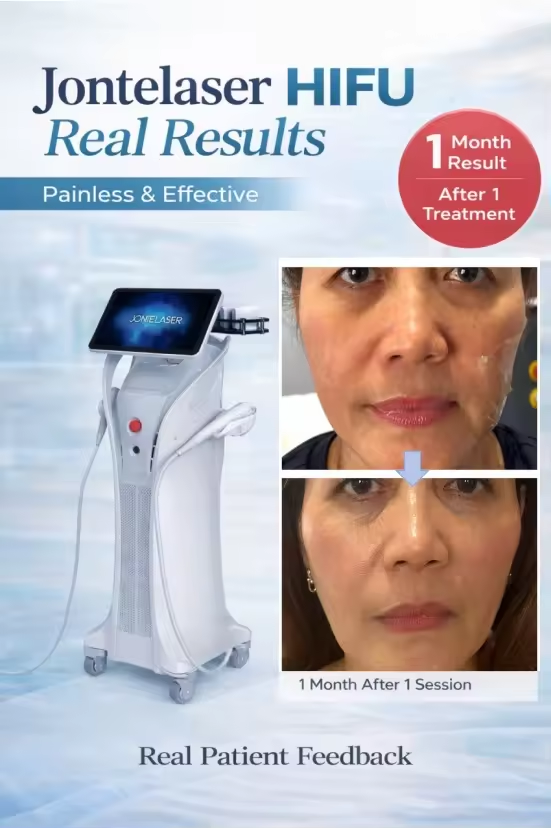
Facial ageing is not a surface phenomenon. Volume loss, ligament laxity and the descent of the deeper soft-tissue support structures are what produce visible sagging at the brow, mid-face and jawline. Surface-level treatments can improve skin quality and fine lines, but a genuine lifting effect requires energy delivered to the deeper structural layers while the skin surface remains intact.
That is the clinical premise behind focused ultrasound. HIFU concentrates ultrasound energy at a precise focal depth beneath the skin, creating small thermal coagulation points in the target layer. The intervening tissue is spared, which is why the procedure requires no incision and leaves no wound to heal. The resulting thermal effect produces immediate collagen contraction, followed by a wound-healing response that builds new collagen over the following weeks and months.
The practical consequence is that focal depth control matters more than raw output power. Energy delivered at the wrong depth either does nothing useful for lifting or places unnecessary thermal load where it is not needed.
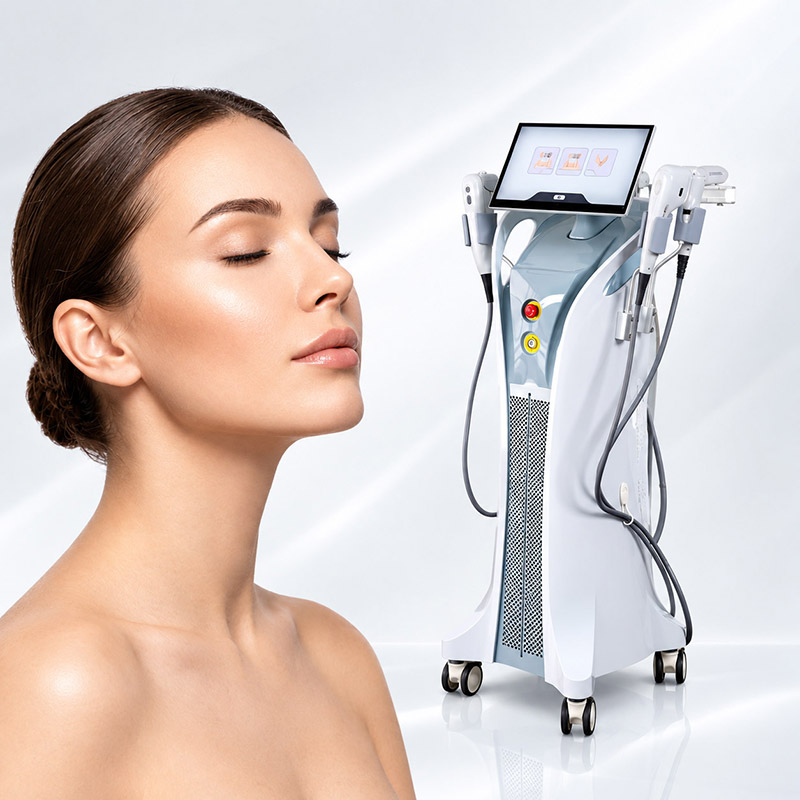
The Terminal Age HIFU Machine’s central design choice is that it does not force one energy pattern onto every indication.
| Mode | Energy geometry | Primary clinical purpose | Typical role in a session |
|---|---|---|---|
| Dot mode | Discrete coagulation points | Focal anchoring and tightening at a selected depth | Precise work on specific lifting vectors |
| Linear mode | Continuous line of energy at a defined depth | Broader regional contraction across an area | Covering the treatment zone for overall tightening |
| Linear + Dot synergy | Both patterns in one treatment plan | Focal plus regional lifting in a single session | Comprehensive plan matched to the patient’s laxity pattern |
Single-mode platforms commit the practitioner to one geometry. In practice, laxity patterns are rarely uniform: a patient may need focal support along the jawline and broader contraction across the cheek and mid-face. Dual mode makes that combination a matter of planning rather than a compromise.
Different anatomical layers respond to different depths, and the appropriate depth differs between patients – by tissue thickness, by body area, and by the severity and location of laxity. A four-frequency transducer system gives the practitioner a broader range of depth options within one platform instead of forcing every patient into a single setting.
In commercial terms this matters for a second reason: a platform able to address the full range of facial indications – from brow and periorbital work to jawline and neck – covers more of the treatment menu from one device investment, rather than requiring separate systems for each depth requirement.
Two patients rarely receive identical parameters, but each patient should receive consistent energy across the whole treatment area. Digital energy control addresses both requirements: it keeps output stable throughout a session, so the energy delivered at the start of a pass matches the energy at the end, and it makes parameters repeatable across sessions so a follow-up treatment can reproduce the earlier protocol.
For multi-operator clinics this is an operational issue as much as a clinical one. Stored and repeatable parameters reduce variability between practitioners and make it possible to document what was actually delivered.
| Approach | Energy / mechanism | Invasive? | Downtime | Best suited to |
|---|---|---|---|---|
| Terminal Age HIFU (Linear + Dot) | Focused ultrasound, dual energy geometry, four frequencies | No | Same-day return to activity | Non-surgical lifting and tightening across facial zones |
| Single-mode HIFU | Focused ultrasound, one energy pattern | No | Same-day return to activity | Straightforward tightening cases |
| RF microneedling | Insulated needles plus radiofrequency at depth | Minimally invasive | Short-lived redness | Texture, pores, acne scarring, dermal tightening |
| Surgical facelift | Excision and surgical repositioning of tissue | Yes | Weeks | Advanced laxity; results beyond the scope of energy devices |
An honest framing matters here: no energy-based platform reproduces surgical repositioning, and a device that claims otherwise invites scepticism. What HIFU offers is a meaningful intermediate option for patients who are not surgical candidates or not willing to accept surgery’s recovery, cost and risk profile.
| Feature | Advantage | Benefit |
|---|---|---|
| Linear + Dot dual mode | Both focal anchoring and regional contraction in one session | One treatment plan addresses uneven laxity patterns |
| Four-frequency transducer system | A wider range of focal depths from one platform | More indications served; broader patient suitability |
| Digital energy control | Stable output through the session and repeatable parameters | Consistent results across passes, sessions and operators |
| Non-invasive delivery | No incisions, needles or anaesthesia | No scarring, no sutures, immediate return to daily activity |
| Facial and body handle coverage | Lifting and tightening beyond the face | Extended treatment menu from a single device |
| Manufacturer support | Training, OEM/ODM, after-sales network | Clinics can launch and scale a service line with backing |
HIFU lifting is generally appropriate for patients with mild to moderate laxity who want improvement without surgery, and for those seeking to delay or avoid a surgical procedure. It is not a substitute for a facelift in advanced laxity, and it is not a fat-reduction or skin-resurfacing treatment – overlapping concerns such as volume loss, pigmentation or acne scarring call for different modalities, which is why patient selection and expectation-setting are part of the protocol rather than an afterthought.
As with any energy-based device, suitability, parameters and the treatment plan are determined by the treating practitioner following the device instructions for use and local regulatory requirements.
The Terminal Age HIFU Machine is manufactured by Beijing JONTELASER Technology Co., Ltd. and marketed under the JT MED brand. The company states 17 years of device R&D experience, 79+ registered technology patents, ISO 13485 certification, CE certification and FDA-related approvals, MDSAP certification across five countries, and a presence in more than 180 countries and regions. The platform launched in 2023.
For clinic buyers, the operational questions matter as much as the specifications: whether the manufacturer provides operator training, whether documentation supports registration in your market, whether consumables and spares are available, and whether the after-sales network can reach you. These are the items worth confirming against your own market’s requirements before purchase.
Is the Terminal Age HIFU Machine painful? Patients typically describe the sensation as heat and a prickling sensation at the treatment depth, without the need for anaesthesia or incisions.
How many sessions are required? It depends on the patient’s laxity pattern and the practitioner’s plan. A course rather than a single session is common, with maintenance intervals set by response.
When are results visible? Some immediate tightening is often described after treatment, with collagen remodelling developing over the following weeks to months.
Are results equivalent to a facelift? No. HIFU is a non-surgical alternative for suitable candidates; it does not reproduce surgical repositioning of tissue.
Can it be combined with other treatments? Yes, and combination is common – for example, HIFU for lifting alongside RF microneedling for texture and dermal tightening, sequenced by the practitioner.
Is there downtime? No incisions are made. Patients typically resume normal activity the same day, with transient redness or tenderness possible.
Can it be used on the body? The platform supports facial and body applications through its handle range; the specific protocol is set by the practitioner.
What should buyers verify before purchase? Market-appropriate certification and documentation, training provision, consumable and spare-part availability, and after-sales reach into your country.
Does it require a medical operator? Requirements vary by jurisdiction. Practitioners should follow local regulations and the device instructions for use.
What is the significance of the four-frequency design? It provides a broader range of focal depths from one platform, which supports a wider set of indications and patient types.
Why does dual mode matter in practice? Because laxity is rarely uniform, and focal anchoring plus regional contraction can be planned in a single session rather than choosing one pattern.