Get a Free Quote in Under 24 Hours


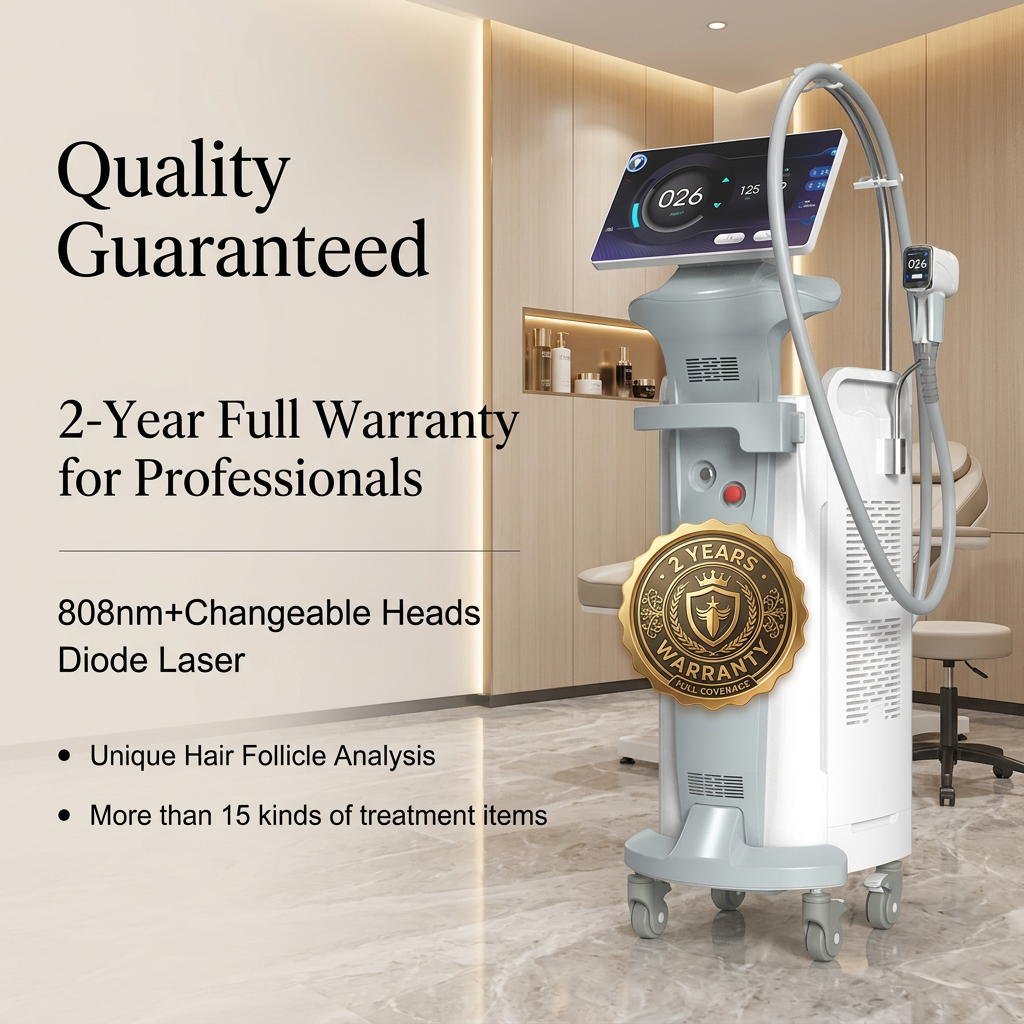
808 nm is still the diode laser benchmark for permanent hair reduction. Test the claim: where it holds, where it fails, and what to verify before buying.
The 808 nm diode laser has been the reference point in professional hair removal for so long that “gold standard” is usually repeated rather than tested. That is a problem for buyers, because a claim nobody can test cannot enter a procurement decision. So treat it as a question: what is 808 nm the standard for, where does it stop holding, and how would a clinic verify it before signing a purchase order?
In procurement terms, a gold standard is the configuration against which alternatives are scored: the reference that fixes the baseline for output stability, cooling behaviour, documentation depth and service economics. It is a measurement convention, not a superlative. Nor does carrying the 808 nm label make a given machine good: two units with the same centre wavelength can differ in output at the handpiece, in drift across a long treatment day, and in whether the paperwork matches the device. A benchmark only works if it can be applied, and a clinic buying on the phrase is buying a label rather than the thing the label was supposed to describe.
Melanin absorbs across the visible and near-infrared spectrum, and that absorption falls as wavelength rises. Tissue scattering moves the other way: longer wavelengths scatter less and reach deeper. A hair removal wavelength must sit where enough photons are absorbed by follicular melanin to cause thermal damage, while enough still reach the structures that regenerate hair. Modern diode platforms divide that trade-off across four wavelengths:
Read as a sequence rather than a menu, these describe one curve, and none is a ranking. The honest version of the claim is narrower than the marketing one: 808 nm is the middle of the curve, the middle is where most patients sit, and that is why it became the reference — not because it outperforms everywhere.
A standard that is never tested becomes a belief. These five profiles are where an 808 nm-only protocol reliably disappoints — and a supplier who will not discuss them is telling you about the rest of the specification sheet.
This list is the argument for treating 808 nm as the default rather than the only tool: a four-wavelength platform routes each profile to a different position on the curve, while a single 808 nm unit serves most of its list well — provided it refuses the cases it cannot serve instead of discounting them into the schedule.
Permanence is a statement about follicle biology, not a device setting. Only follicles in the growth phase, with sufficient pigment and an intact connection to the structures that regenerate the fibre, are vulnerable to selective photothermolysis. A single session reaches a fraction of the follicles in an area, which is why a course exists and why spacing is a clinical decision, not a scheduling convenience.
So permanence accumulates: each properly delivered session removes capacity from a subset of follicles, and the visible result is the sum across the growth cycle. A clinic that compresses the interval to fill its calendar trades a short-term booking pattern for a long-term outcome the patient notices at twelve months. Hormonal change can also reopen a closed question by recruiting dormant follicles, which is why maintenance belongs in the consent conversation.
What a clinic should promise is a durable reduction after a completed course, delivered by a trained operator using parameters matched to the patient. What it should never promise is zero regrowth, or that an 808 nm handpiece guarantees a result independent of technique.
Use this as a scoring sheet, not as a description of any particular unit. Each row is a dimension where an 808 nm platform either meets the reference standard or quietly falls short.
| Benchmark dimension | Meeting the standard | Falling short | Commercial consequence |
|---|---|---|---|
| Wavelength and coverage | 808 nm verified as the operating centre, with 755/940/1064 available if claimed | Wavelength quoted from a brochure, no configuration-matched record | Case mix capped by the platform, not the operator |
| Output at the handpiece | Delivered output stated and measurable at the handpiece | Only a nominal source rating offered | Session time and comfort set by invisible losses |
| Stability under load | Output holds across a full treatment day | First patients respond differently from the last | Inconsistent outcomes, repeat requests |
| Cooling architecture | Semiconductor (TEC) cooling that stays cold during sustained firing | Cooling specified but untested under continuous load | Discomfort limits fluence, which limits result |
| Spot size and changeover | Spot options matched to area, swapped without calibration drift | One spot forced onto every area | Large areas slow, small areas risky |
| Bar provenance | Documented bar source, batch traceability, stated replacement terms | Provenance unstated, replacement cost undefined | Cost per session drifts upward unannounced |
| Technical file depth | File matches the shipped configuration for registration and inspection | Generic file reused across unrelated models | Import and inspection exposure after payment |
| Feature | Advantage | Benefit to the patient | Benefit to the clinic |
|---|---|---|---|
| 808 nm centre within a 755/808/940/1064 nm platform | Reference performance on typical pigmented terminal hair, with adjacent wavelengths for edge cases | Predictable response, and a route for skin and hair types the default would miss | One platform covers a wider booking list without refusing patients |
| 1200 W and 1800 W configurations | Power headroom matched to intended throughput rather than a headline number | Shorter, more comfortable passes on large areas | Capacity is a purchasing decision, not a scheduling constraint |
| Semiconductor (TEC) cooling | Contact cooling that holds through sustained firing | Less discomfort, fewer abandoned sessions | Therapeutic settings without trading down for comfort |
| Replaceable spot sizes | Area-appropriate delivery without recalibration drift | Faster large-area work, gentler small-area work | Session economics improve in both directions |
| Calibrated, repeatable output | Consistent performance across the day and across operators | Results that do not depend on who is on shift | Outcome variance stops being an operational lottery |
| 808 nm core without unnecessary complexity | Fewer parameters to get wrong in routine use | Safer early sessions during the learning curve | New staff become productive without diluting the protocol |
A benchmark claim is only as strong as the factory behind it. JT MED platforms are manufactured by Beijing JONTELASER Technology Co., Ltd., founded in 2004, exporting to more than 50 countries. Manufacturing runs under an ISO 13485 quality management system, the company participates in the MDSAP audit programme, and documentation is structured to align with CE and FDA-cleared market requirements. The portfolio spans diode laser hair removal, CO2 fractional laser, HIFU, RF microneedling, Q-switched laser and body contouring, with OEM/ODM services for distributors and clinic groups.
The useful part of that paragraph is not the list of standards but the documents they generate: a quality certificate naming the manufacturing site, a technical file matching the configuration on the invoice, dated calibration records, and traceability for the laser bars. A supplier working under a genuine quality system produces those four as routine output; one assembling from catalogued components produces excuses.
No. It means 808 nm is the reference other options are compared against, because its position on the absorption-to-penetration curve suits the largest share of typical cases. Very dark skin with fine hair, heavy grey coverage or deep coarse terminal hair is usually served better by another position on the same curve, or by a multi-wavelength approach.
Reduction is a durable decrease in regrowing hairs after a completed course, which is what labelling in most markets supports. Removal would imply every follicle has been eliminated, which selective photothermolysis does not achieve, because not all follicles are in a vulnerable growth phase when treated.
Request output measured at the handpiece rather than at the source, witness a measurement during the demonstration, and compare the technical file against the exact configuration quoted. A supplier who cannot produce a configuration-matched document is asking you to accept the claim on trust.
Wavelength is one input among several: parameter selection for skin type and hair calibre, spacing against the growth cycle, cooling discipline and operator technique all move the outcome. Identical hardware with different protocols produces different twelve-month results, which is why training quality belongs in the purchase decision.
Judge the trend, not a single session. A course is built around the growth cycle of the area, so the meaningful assessment point comes after the full course is delivered with correct spacing. Clinics that evaluate too early tend to over-treat, and over-treatment costs comfort and safety with no efficacy return.
It can reopen the picture in hormonally influenced areas by recruiting dormant follicles, which is why maintenance should be discussed before treatment rather than after. This is a consent issue more than a device issue, and handling it honestly protects the patient relationship.
For a clinic whose bookings are dominated by Fitzpatrick I to IV patients with pigmented terminal hair, yes: simpler to train, simpler to maintain, easier to run consistently. The calculation changes when the local population includes a large share of very dark skin, fine facial hair or grey coverage, because those cases will be refused or under-served.
Larger spots cover area faster but control small or contoured regions poorly; smaller spots are precise but slow on legs and backs. Replaceable spot sizes let the clinic match delivery to the area, shortening large-area sessions and removing the temptation to over-power small ones.
At minimum a quality certificate naming the manufacturing site, a technical file matched to the shipped configuration, dated calibration records, and traceability for the laser bars. Where registration is required, the file must describe the device as configured, not a generic platform from the same catalogue.
Response time, spare handpiece availability, calibration intervals, bar replacement pricing and the terms under which the manufacturer supports the specific configuration shipped. Cooling components and handpieces decide uptime, so the agreement should name them.
If the standard is worth invoking, it is worth documenting. The JT MED export team can supply the 808 nm platform specification, 755/808/940/1064 nm configuration options, 1200 W and 1800 W variants, quality documentation under ISO 13485 and MDSAP, and OEM/ODM terms. Request the catalogue, a configuration-specific quotation, and the four documents above.