Get a Free Quote in Under 24 Hours


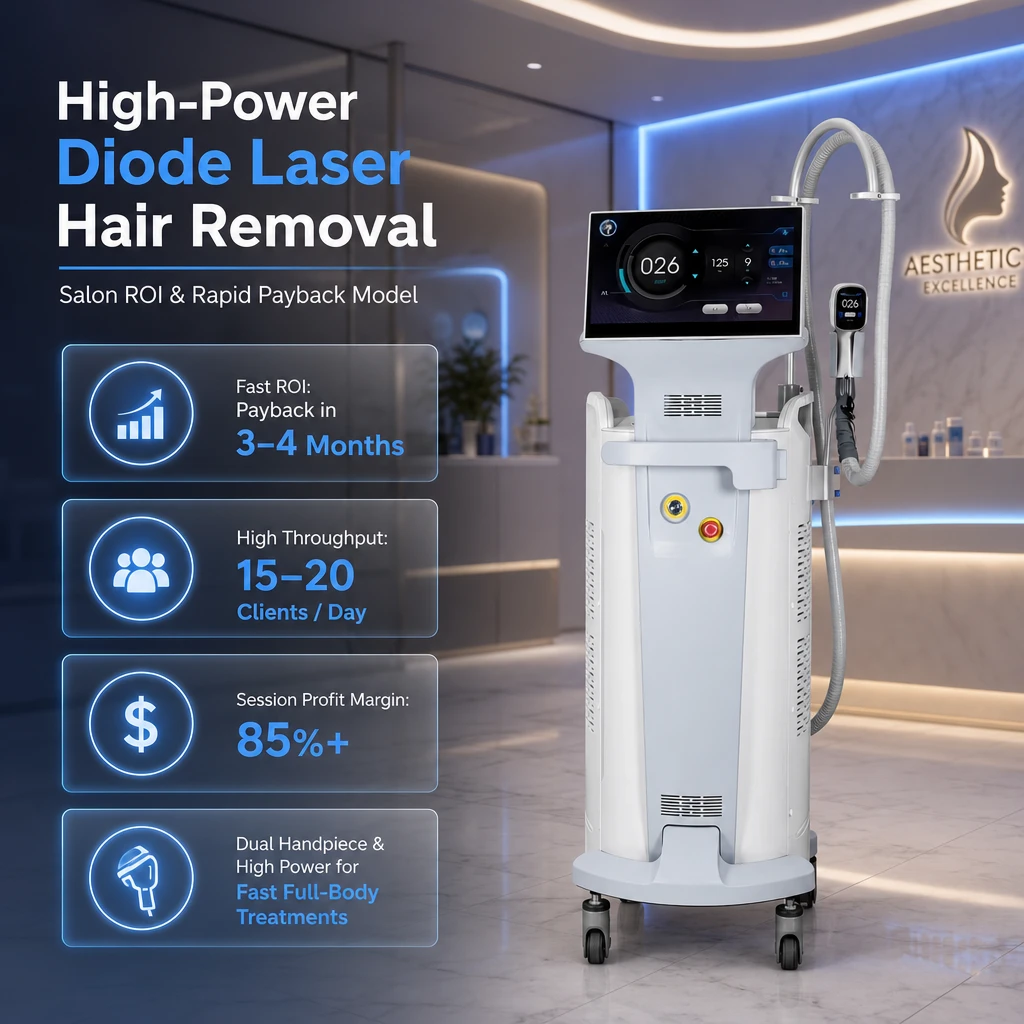
What does ROI mean for high-power diode laser hair removal equipment? The number of billable sessions the platform completes before its installed cost is recovered – not the gap between two quotes.
Which input moves a payback calculation most? Completed sessions per week. Price and equipment cost are visible and negotiable; weekly completed sessions are the number a salon actually controls.
Does higher power improve ROI automatically? No. Optical power shortens treatment time only when spot size, cooling and operator technique are matched to it. Unbalanced, it raises the electricity and service bill without adding booked slots.
Can a supplier tell me my payback period? Only with your price list, your room hours and your variable cost per session. A figure quoted without those three inputs is marketing, not arithmetic.
What erodes a good diode laser payback fastest? Idle room-hours, unplanned downtime, and re-treating the same area after inconsistent energy delivery.
Return on investment, for a diode laser hair removal platform, is the relationship between the billable treatment time a device generates over its service life and the total cost of owning it – purchase, installation, consumables, operator hours, service and downtime. It is a throughput question before it is a price question.
Most salon purchase decisions start with the quote, because it is the only number on the table. Two platforms at the same price can differ by a factor in how many appointments they absorb inside an eight-hour day, and two at different prices can converge on the same payback week once operator minutes count. The purchase price is the denominator of a fraction whose numerator is billable minutes.
What follows is that arithmetic: four inputs, one formula, where high power genuinely changes the result, and the costs that quietly eat the gain. All figures are index values, so the model scales to your own currency.
Only four numbers are needed. If a supplier cannot discuss all four, the conversation is about hardware, not your business.
The payback relationship is short enough to hold in your head: weeks to recover = installed cost divided by (weekly sessions multiplied by contribution margin per session, minus weekly fixed ownership cost). Everything else here is about enlarging the middle term and shrinking the last one.
High power refers to the optical output a platform delivers to tissue, expressed in the 1200 W and 1800 W configurations common in professional diode platforms. Watts appear nowhere in the payback formula; they matter through three channels that do.
Shorter pulses at a given fluence mean a leg, a back or a full face finishes sooner. If a session falls from a long appointment band into a shorter one, the same room-hour yields more appointments, and the weekly session count rises without extra marketing spend.
Power converts into time only when the spot is large enough to use it. A high-output engine behind a small spot still needs many overlapping passes, and the passes – not the wattage – decide appointment length. Ask for spot dimensions and recommended overlap for the protocol you intend to sell.
Output that drifts as the handpiece heats up produces uneven results, and uneven results produce touch-up appointments that consume paid room time without revenue. Semiconductor (TEC) cooling and stable calibration are financial features, not comfort features. A platform that holds output on appointment nine behaves like one with more capacity than its spec sheet claims.
The model below uses index units: installed cost of 100 units, contribution margin of 1 unit per session. Payback is then 100 completed sessions, and the only question is how quickly your calendar delivers them. To rescale, divide your installed cost by your contribution margin.
| Sessions completed per week | Sessions needed to recover 100 units | Weeks to payback | Room-hours consumed (approx.) |
| 8 | 100 | 12.5 | 50 |
| 15 | 100 | 6.7 | 38 |
| 25 | 100 | 4.0 | 31 |
| 40 | 100 | 2.5 | 25 |
Two readings follow. The gap between eight and forty sessions a week is not a five-fold difference in effort – it separates a machine that pays for itself inside a quarter from one that takes most of a year. The room-hour column shrinks only because shorter appointments fit more work into the same hours, which is exactly where the high-power decision earns or fails to earn its premium.
Run the table again with margin cut by a promotional discount: it lowers the numerator of every row while installed cost stays fixed.
A higher-output platform draws more current and rejects more heat. In a small, poorly ventilated room the cooling system works harder, ambient temperature climbs, and operators shorten sessions or pause between patients. Budget electrical and ventilation work inside installed cost rather than discovering it in the first summer.
Ask for spare-part lead time in writing. A handpiece that takes weeks to arrive turns a serviceable asset into a depreciating object occupying a room. Calibration belongs in the same conversation: an uncalibrated unit delivers results the operator cannot defend, and defensibility is what keeps a course renewed.
Consumable load is small per session and significant per year. Operator minutes are the larger hidden cost, paid whether or not the appointment converts. Features that cut handling time – lighter handpiece, faster setup, preset protocols – pay back through labour rather than electricity.
Downtime is the only cost here that compounds: it removes revenue, breaks course schedules and pushes patients toward whichever competitor keeps their appointment. A written response-time commitment beats a longer warranty that excludes the parts most likely to fail.
Salons often price hair removal by copying the clinic down the road, then discounting to win first bookings. That destroys the middle term of the payback formula before the machine is installed. Three structures hold up better.
Whatever structure you choose, compute contribution margin at the discounted price first. A promotion cutting margin per session by a third needs roughly fifty percent more completed sessions to reach the same payback week.
The comparison that matters is not which technology is clinically superior, but which returns its cost inside the room hours you can actually sell.
| Platform | Billable minutes per room-hour | Patient eligibility breadth | Consumable load | Where the payback case is weakest |
| High-power diode (755/808/940/1064 nm) | High – short appointments on large areas | Broad, spanning skin tones and hair types when protocols match | Low | Under-utilised rooms; the premium is wasted if the calendar is empty |
| Standard-power diode | Moderate | Broad, with longer bands on large areas | Low | High-volume calendars, where appointment length caps revenue |
| IPL | Moderate to low | Narrower envelope at higher fluence | Moderate – gel and filters | Case mixes with darker skin tones and coarse hair |
| Alexandrite | High on suitable skin | Narrow on darker skin tones | Low | Mixed-population salons, where eligibility limits bookings |
Read the last column first: every platform here can produce an attractive payback on paper, and the column that separates them is the condition under which the case fails.
| Feature | Advantage | Benefit to the clinic | Benefit to the patient |
| 1200 W / 1800 W optical configurations | Output headroom for short pulses on large areas | More appointments per room-hour at stable quality | Shorter appointments, fewer sessions |
| 755 / 808 / 940 / 1064 nm wavelength set | One platform spans hair colours, thicknesses and skin tones | Wider booking eligibility from one asset | A plan matched to their hair and skin, not the machine |
| TEC semiconductor cooling | Sustained output and controlled skin temperature | Fewer aborted sessions and touch-ups | Predictable comfort without routine topical anaesthetic |
| Selectable spot sizes | Large spot for limbs, small spot for facial detail | Appointment length matched to the area sold | Faster large-area work, precision where it matters |
| Preset clinical protocols | Less setup and decision time per patient | Lower operator minutes | Consistent treatment from any trained operator |
| Calibration and self-diagnostics | Documented output between service visits | Defensible results, fewer disputes | Delivered dose equals planned dose |
| OEM/ODM options | Branding and protocol sets to order | Distributors build their own product line | Locally supported service and documentation |
The numbers in a quotation are only as reliable as the manufacturer behind them. JT MED platforms are manufactured by Beijing JONTELASER Technology Co., Ltd., a medical aesthetic equipment manufacturer operating since 2004, with installations in more than 50 countries and an OEM/ODM business for distributors and clinic groups.
Quality and market access are documented through ISO 13485 certification and MDSAP participation, with CE-marked configurations for Europe and FDA-cleared configurations for the United States. Two clarifications matter: FDA-cleared describes a specific cleared indication for a specific model and is not FDA approval or FDA certification. A supplier using the stronger wording invites reliance on a claim that will not survive due diligence.
Ask for the certificate scope rather than the certificate image, the notified body details behind the CE marking, the clearance reference for the exact model, and a factory acceptance test record for the unit shipped. A manufacturer answering all four quickly is telling you how the machine will be supported.
Put those nine answers into the payback model as ranges, not single figures. A supplier who can support a range is describing a machine; one who can only quote a price is describing a transaction.
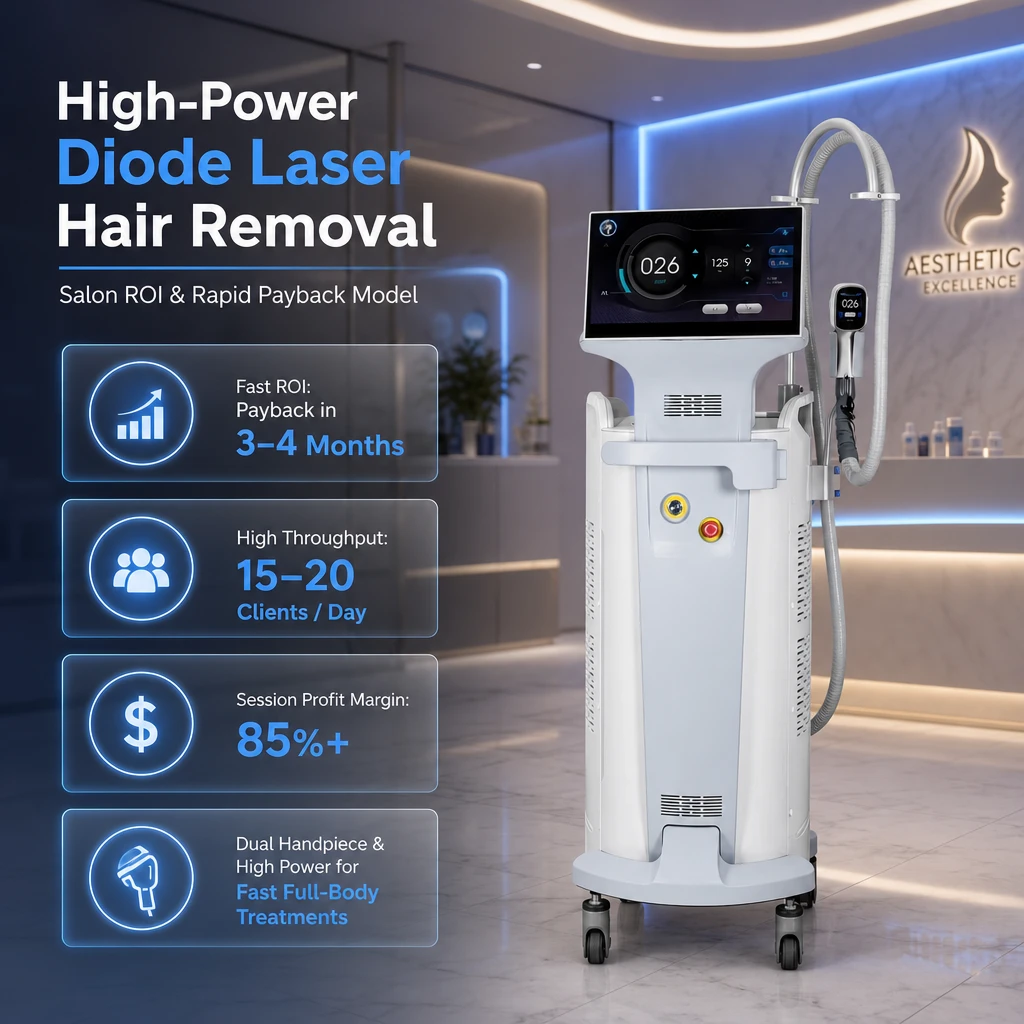
It depends on contribution margin and weekly completed sessions. In the index model above, 25 sessions a week at one unit of margin recovers 100 units of installed cost in about four weeks of equivalent margin – but realistic ramp-up means most new rooms take far longer to reach that rate. Negotiate against the formula, not a benchmark.
Start from the hours the room is staffed, then discount for the share you can realistically sell in the first two quarters.
Only if your book carries large-area work at volume. For facial and small-area work, the extra output buys headroom you rarely use while the electrical and cooling requirements still apply.
Price from your contribution margin, not their list. A competitor charging less may run a lower-cost platform with longer appointments – or may be buying volume at a loss.
Gel, disposables, laundry and operator minutes. The first three are small; operator minutes dominate – which is why time-saving features change economics more than invoice-shortening ones.
Usually, in a mixed-population market, because eligibility breadth converts enquiries a narrow platform must decline. In a homogeneous market the advantage largely disappears.
Leasing preserves cash but raises the fixed ownership term; buying lowers total cost of ownership if you keep the platform past its payback period. Compare both against identical session assumptions.
More than the treatment. Add consultation, patch test review, preparation, aftercare instruction and room reset – then time the full cycle with a stopwatch rather than estimating.
A handpiece that fails without a local spare. Lost bookings and rescheduled courses usually cost more than the part.
Convert both to installed cost, contribution margin per session, and minutes per session for the same treatment area. Quotes identical on price usually differ widely once minutes are counted.
Factory acceptance test data at the handpiece, certificate scope for ISO 13485 and MDSAP, CE notified body details, the clearance reference for the exact model, and a written spare-part lead time.
The JT MED export team supplies the material this article says to ask for: configurations across 1200 W and 1800 W platforms, the 755/808/940/1064 nm wavelength set, spot size and handpiece specifications, consumable and spare-part pricing, certification scope, and the training schedule. For a multi-site rollout or private-label line, the OEM/ODM team quotes configuration, branding and lead time together.
Send your treatment mix, room count and target session price, and the team returns a recommendation against those inputs rather than a generic price list – the four-number model above, applied to your salon.