Get a Free Quote in Under 24 Hours


In short: on 25 June 2026, Beijing JONTELASER Technology Co., Ltd. published four Onda Coolwave case reports – two patient-side outcome notes and two operator accounts. This article reads them critically, separates what they evidence from what they only illustrate, and turns them into a recording method for clinics evaluating a 2.45 GHz microwave body contouring platform. It reviews a vendor casebook, not a controlled trial.
The write-up is short: four entries, each with a profile, a protocol where one is given, an attributed quotation, and – in two of the four – a numeric outcome. There are no patient identifiers, no before-and-after imaging, no independent assessor, and no stated measurement protocol. That is normal for brand material, and it sets how to read it. A vendor casebook is strongest as evidence of how a device is used and what operators report, and weakest as evidence of expected effect size in your population.
The first entry describes a 34-year-old woman, 18 months post-delivery, with stubborn localised abdominal fat and skin laxity. The recorded protocol is four sessions spaced four weeks apart, roughly 15 minutes each. The reported outcome is a 4.5 cm reduction in waist circumference with visible abdominal tightening. The patient quotation focuses on sensation: a cool surface with heat felt deeper, and no downtime afterwards.
Two details matter more than the number. The four-week interval fits a monthly rebooking conversation rather than weekly attendance, so a four-session course lands inside about three months. The 15-minute session is what makes the lunch-break positioning in Case 3 arithmetically possible.
What the entry omits is where the tape was placed, whether one operator measured every visit, the baseline circumference, and what happened 8 to 12 weeks after the final session. A single figure without those controls is an operator observation, not a number for a brochure .
The second entry concerns a 28-year-old woman with Grade 3 cellulite on the posterior thighs, dimpling visible at rest rather than only on pinch. The protocol is targeted treatment of the fibrous septae using the Onda “Deep” handpiece across three sessions. The attributed result is a clinician’s statement that skin smoothness improved by more than 70% after the third session.
The mechanism claim is the part worth extracting: the account argues that microwave energy reaches the vertical fibrous septae responsible for dimpling, where radiofrequency-based devices have a harder time. Whether or not you accept the percentage, the anatomical target is testable, and it changes how you audit a demo – applicator depth, the energy range on the deep mode, and how superficial and deep treatment are chosen on the same patient.
“More than 70%” on a smoothness judgement is a subjective scale with no blinding and no named instrument. Treat it as a clinician’s impression. Three sessions is shorter than Case 1’s four, which matters when modelling your session count.
The third entry shifts from patient to buyer. The owner of a European aesthetic group reports that body sculpting revenue grew by 40% after the Coolwave device was introduced, citing two reasons: treatments fit into a lunch break, so the device sells as a time-boxed appointment; and the platform runs without consumables, contrasted with the anti-freeze membranes used in cryolipolysis.
This is the most transferable entry: the logic does not depend on any single patient. A body contouring line is a room-hour business. If a treatment takes 15 minutes and needs no membrane, no gel cartridge and no per-cycle disposable, the marginal cost of one more appointment is close to the cost of the room and the operator’s time.
A 40% figure from one group, however, is produced by pricing, marketing, staffing and location as much as by the device. Rebuild it from your own inputs: session price, sessions per room-hour including turnover, operator cost per hour, and a service reserve. The consumable saving models easily; revenue growth is not a specification.
The fourth entry is a dermatologist in South America describing patients with Fitzpatrick IV to VI skin. The argument is that microwave energy is not absorbed by melanin, so it passes through the skin to reach subcutaneous fat – an advantage over devices whose energy is taken up by pigment.
Read this as a physics rationale, not an outcome dataset: no patient count, sessions, adverse events or follow-up are given. It does establish a legitimate question: if your base includes darker skin types, compare energy that targets pigment with energy that does not, and request the device’s safety and electromagnetic compatibility test reports rather than a claim about suitability.
| Entry | Recorded | Supports | Does not support |
|---|---|---|---|
| Case 1 – abdomen | 4 sessions, 4-week intervals, ~15 min; 4.5 cm reduction reported | A workable course rhythm and appointment length | An expected result for your patients |
| Case 2 – cellulite | 3 sessions, “Deep” handpiece, septal targeting | Applicator and depth as protocol variables | A validated percentage or modality comparison |
| Case 3 – European group | Revenue growth reported; zero consumables | The consumable-free cost structure | That your revenue moves the same way |
| Case 4 – South America | Fitzpatrick IV-VI treated; melanin rationale | A basis for skin-type and document requests | Safety or efficacy rates in darker skin |
Four fields make an anecdote defensible in a tender:
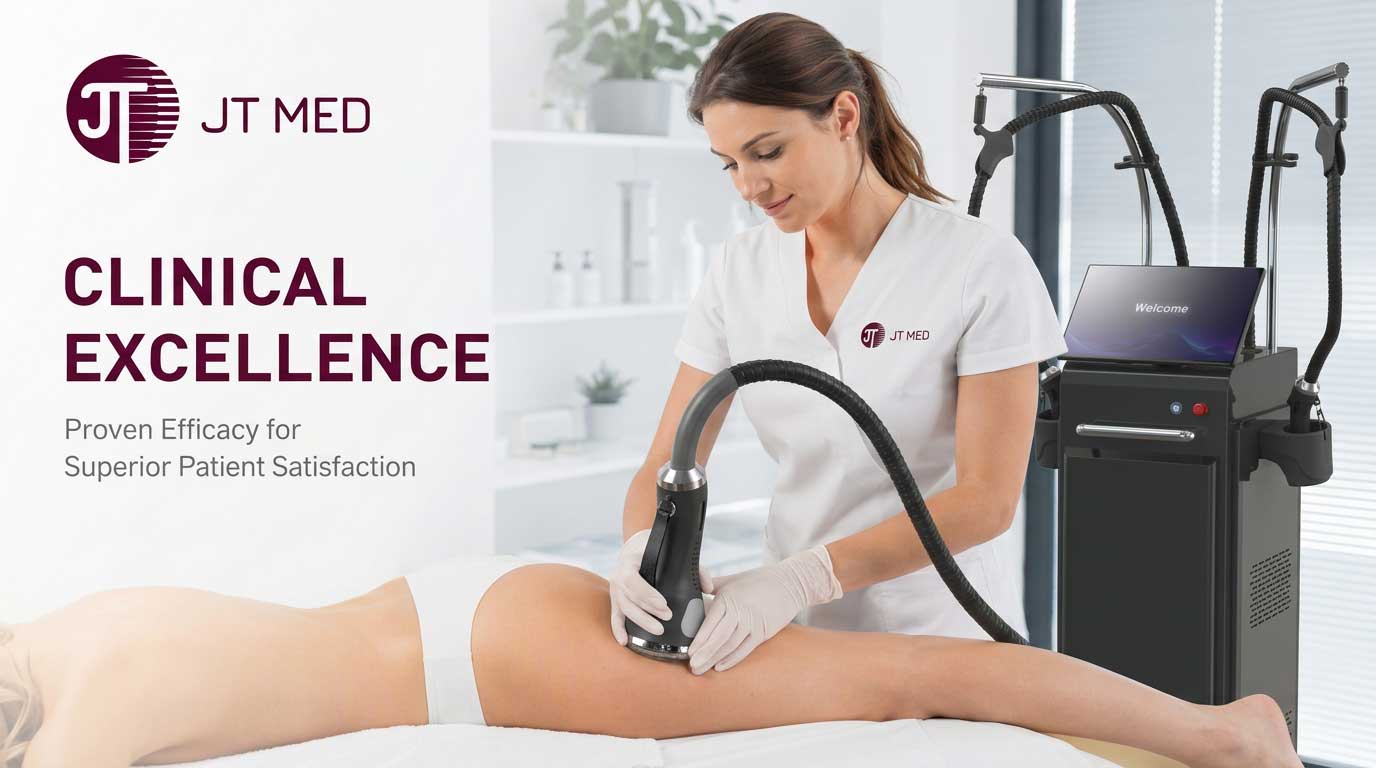
The Coolwave Microwave slim Machine is a 2.45 GHz microwave body contouring platform. JONTELASER’s published description states integrated cooling that holds the skin surface at a comfortable temperature, concentration of the majority of delivered energy in the subcutaneous fat rather than the dermis, and one platform addressing localised fat, cellulite and skin laxity. The company manufactures under an ISO 13485 quality management system.
None of that predicts a centimetre figure for a given patient. Selection, baseline adiposity, protocol adherence and technique all sit between specification and outcome.
The four reports are the company’s own material about its own device. They do not establish a controlled effect size, they are not a substitute for a clinical evaluation in your market, and results differ between patients and operators. Clinics should ask for protocol documentation, the safety and EMC test reports, and the service schedule, then measure from their first treated patient.
The full casebook and protocol documentation are available at info@jontelaser.com.